

When One Language is Not Enough (Sometimes, Too Much)
Three things I loved this week: the Heated Rivalry monologue, motherhood & signing at the Olympics and a "sociological record" of women
One week to go until the release of the paperback edition of Mother Tongue Tied (Feb. 26). You can pre-order here and if you’d like me to send you a signed copy, please get in touch and I will arrange it. For my North American friends, it will be distributed in Canada and U.S. from May so it will be much easier to get your hands on a copy. Stay tuned for some translation news and bear with me as I mention its upcoming release a few more times because a girl has to do some marketing.
Thank you as always for all the support!
For today’s newsletter, three things I loved this week:
The Double Duty of that Russian Monologue in Heated Rivalry
I finally finished watching Heated Rivalry upon the urging of my friend, L (thank you!). My heart and head nearly exploded in episode 5 right before Ilya delivers his Russian monologue on the phone to Shane. Yes it was beautiful and impressive, but the reason I was so excited is because this right here is my area of linguistics research, and I have an entire chapter on love in multiple languages in MTT. This is the part where I say, if you loved Rozanov’s Russian monologue in ep. 5 of Heated Rivalry, you will love the chapter “Kocham Cię” (translation: I love you) in Mother Tongue Tied so pre-order the paperback now!
A quick recap: Ilya, a bilingual Russian hockey player and one of the main characters in the show calls Shane, his love interest, a non Russian-speaking Canadian. Ilya is in Moscow as his father has just died, his family is complicated, there is a lot of hurt, anger, grief and confusion going on in his life in addition to the colossal burden of having to hide his love for Shane from the rest of the world and in a way, from himself. Shane asks how Ilya is doing to which Ilya replies, “English is too hard right now” [to explain].
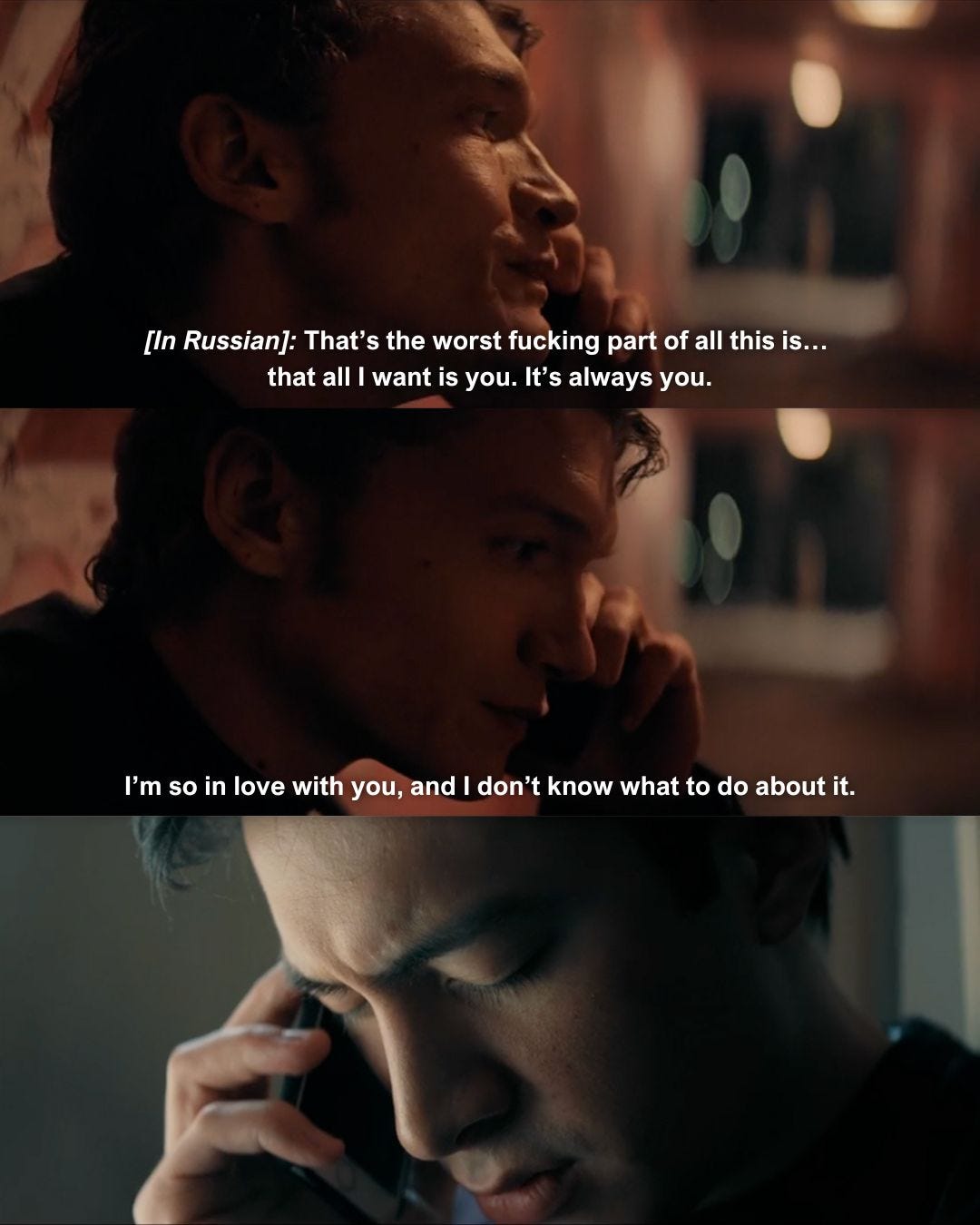
And here is where it gets so linguistically marvellous! Shane replies that he wishes he spoke Russian; Ilya jokes he could probably learn it in a week with no accent and then inserts a “Bonjour”; Shane tells him “that’s French”; Ilya, with his deadpan humour, says he knows, and then Shane tells Ilya that if he wants, he can say everything on his mind in Russian. Shane won’t understand a word of it but maybe it will help Ilya release some of the heavy feelings he’s holding. Ilya agrees and launches into a long monologue in Russian sharing about his complicated family, his trauma around his father’s death, how he never wants to return to Russia and finally, how the worst part of it all is that all he wants is to be with Shane.
And here I begin my monologue on multilingualism and emotions! Research has shown multilinguals often report feeling more emotionally connected and able to communicate feelings and emotions in their first language which tracks in this scene because Russian is Ilya’s first language and for now, still his dominant one. He is fluent in English but when it comes to deep emotions, for example, grief and love, he needs his first language to express those feelings.
As Pavlenko (2004) outlines, because the first language is always acquired in a natural environment, “through perceptual and affective channels, it becomes integrated into the limbic system, which, among other things, is responsible for emotions, drives, desires and motivation. In the process of first language socialisation, L1 words and phrases acquire affective connotations and become integrated with emotionally charged memories.” (Think here also about swearing in different languages and how it may feel different, possibly less meaningful, depending on the language you use.)
But, linguistics plot twist (!) it is not always that straightforward. Other studies have shown that a prolonged socialisation in another language can shift this emotional connection to a second language. So, for example, if Ilya gets American or Canadian citizenship, as discussed in ep. 6, he might start to feel more attached and comfortable in English even when it comes to his emotions.1 His attitude to Russia is extremely negative and he goes as far to say that he hates it. And that too can influence the use of a language and its emotional connection, especially when the second language starts to become a dominant language, one that feels easier to use in most situations. This is something that also comes up often for parents raising multilingual children in a heritage language. Like any language of love and emotion, there are many internal and external factors and dimensions influencing parent-child emotional communication.
As for Ilya’s emotional confession in HR about wanting to only be with Shane, in a study on the emotional weight of I love you in multilinguals’ languages (Dewaele, 2008) the majority of speakers felt I love you was strongest in their first language. But, there was much more at play, including self-perceived language dominance and proficiency, context of acquisition and age of onset of learning of the second language, degree of socialisation, and the nature of the interlocutors in the second language.
Another study about multilingual couples showed that although there may have been emotional distance at the beginning between the languages and therefore, partners, the longer relationships led to affective socialisation and the partner’s language often became the language of the heart (Dewaele & Salomidou, 2017). Also, sometimes people choose to use their second language (often the non-dominant one) to express something they might need to, in a way, test out. For example, this is what I did when I first told my now husband I loved him. Not only did I do it in Polish, yes, my first language but not my dominant one, I wrote it in a card because it felt safer and somewhat removed (read all about that here!)
Linguistically and emotionally, Ilya’s Russian monologue is doing double duty: he is using Russian to express his emotions in what he believes is a more authentic and “natural” way that is of course easier for him than English. But, he is also revealing his true feelings to Shane in a language Shane does not understand. He can’t say how he feels to Shane in English, not yet at least, so he says it in a language that is safer, yes more emotional and his language of the heart but also, for the interaction itself where he is also revealing his true feelings to himself, more removed. It feels safe and without consequence because the only person listening does not understand. It is a powerful scene, accompanied by Beethoven's Moonlight Sonata, and even if you are not watching the series, I urge you to watch this one scene online.
Motherhood & Language at the Olympics
There are so many amazing Olympic moments so far but for me, Elana Meyers Taylor, the 41-year-old most decorated female bobsledder in the sport's history is on top. The mom of two deaf children has brought American Sign Language into the spotlight at the Olympics, specifically the topic of how hearing parents of deaf and hard of hearing children are in the minority when it comes to learning sign language. After she was seen signing with her children, as was her partner, people began posting statistics on how fewer than 23% of hearing parents of deaf children learn a sign language. It is a staggering low number with sometimes devastating consequences and you can read more on those stats here.
A Sociological Record of Polish Women by Zofia Rydet
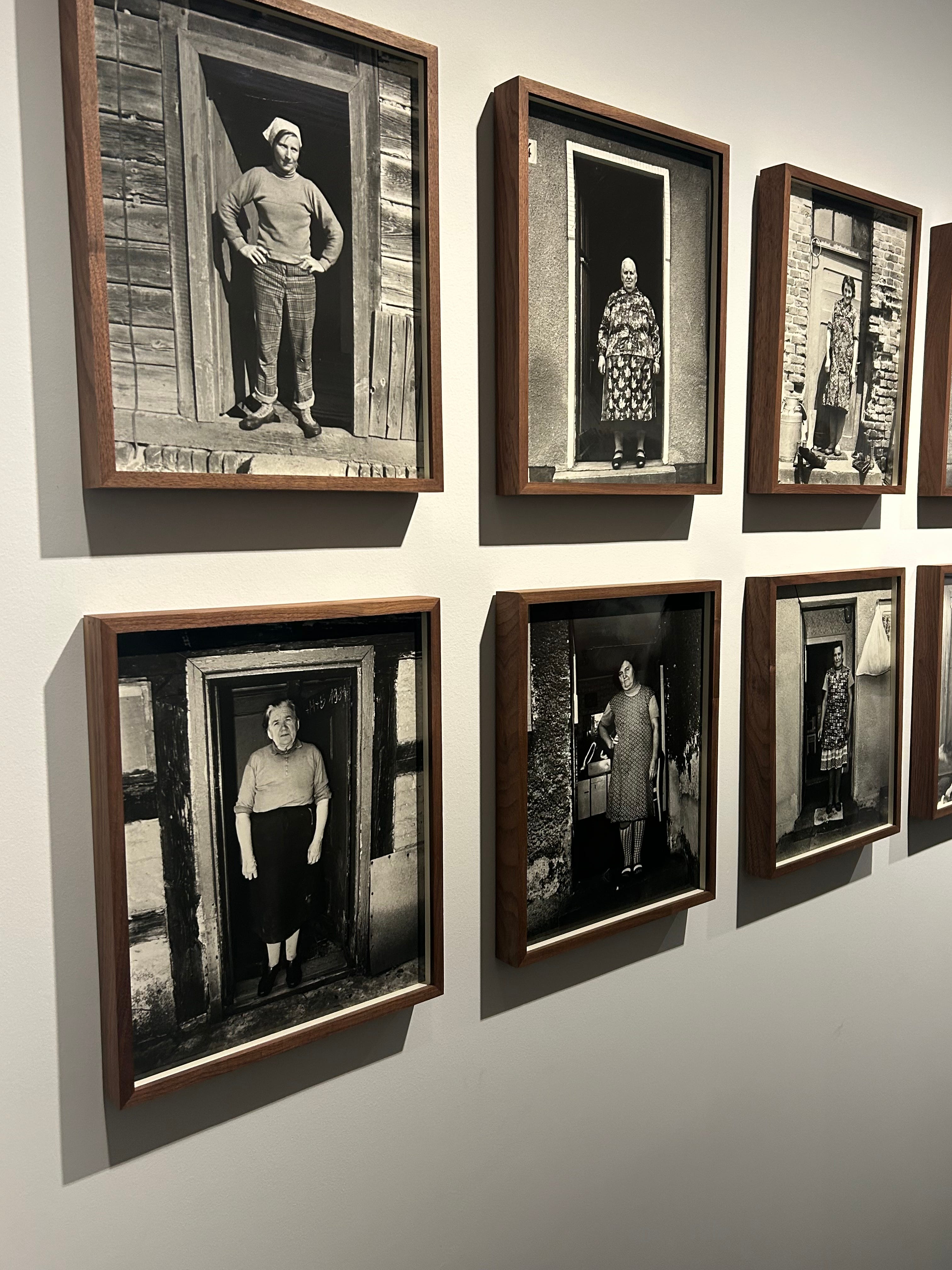
Lastly, if you are around London this weekend, go see the Zosia Rydet show at the Photographer’s Gallery, titled Sociological Record. (It closes Sunday.)
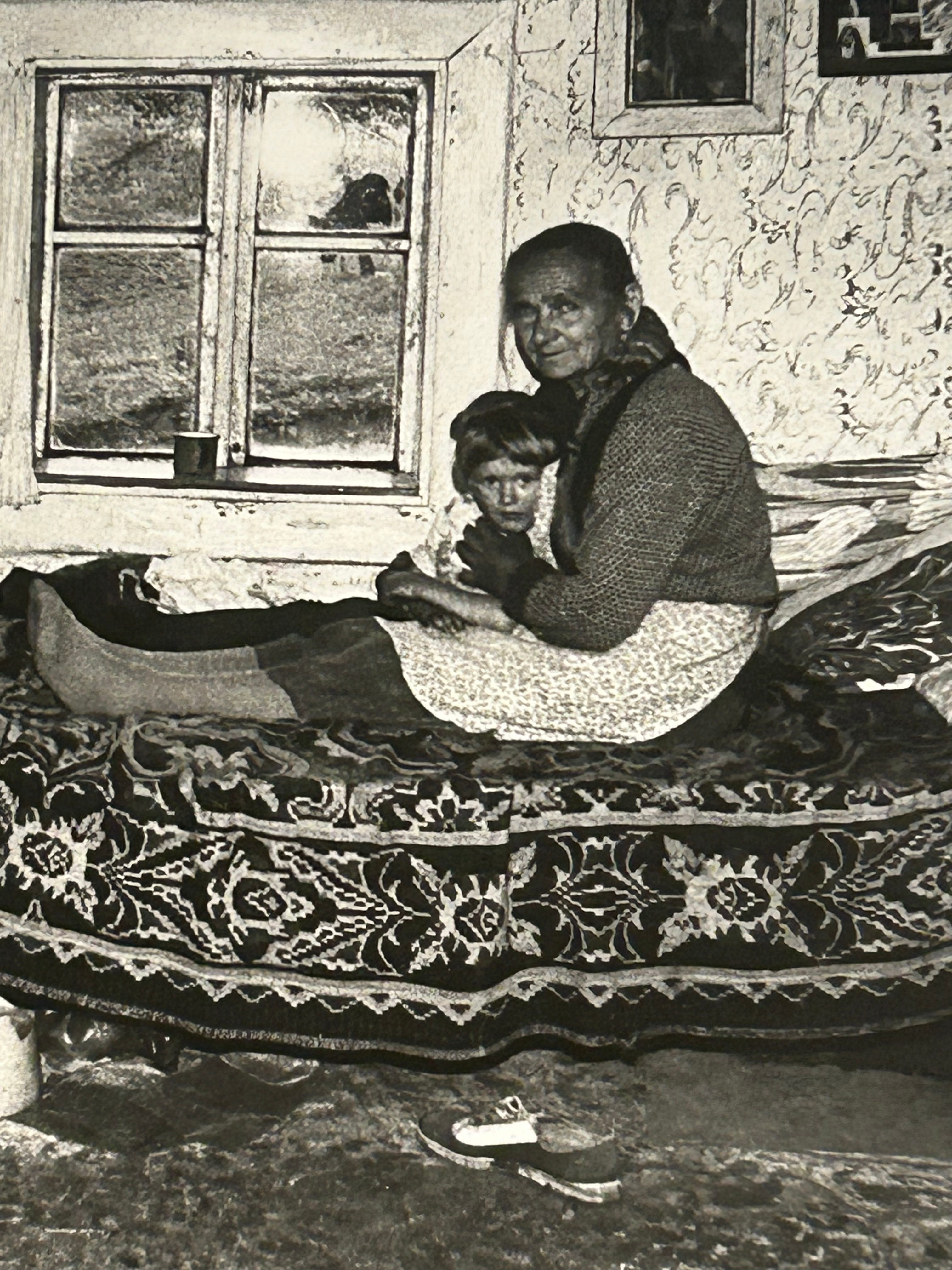
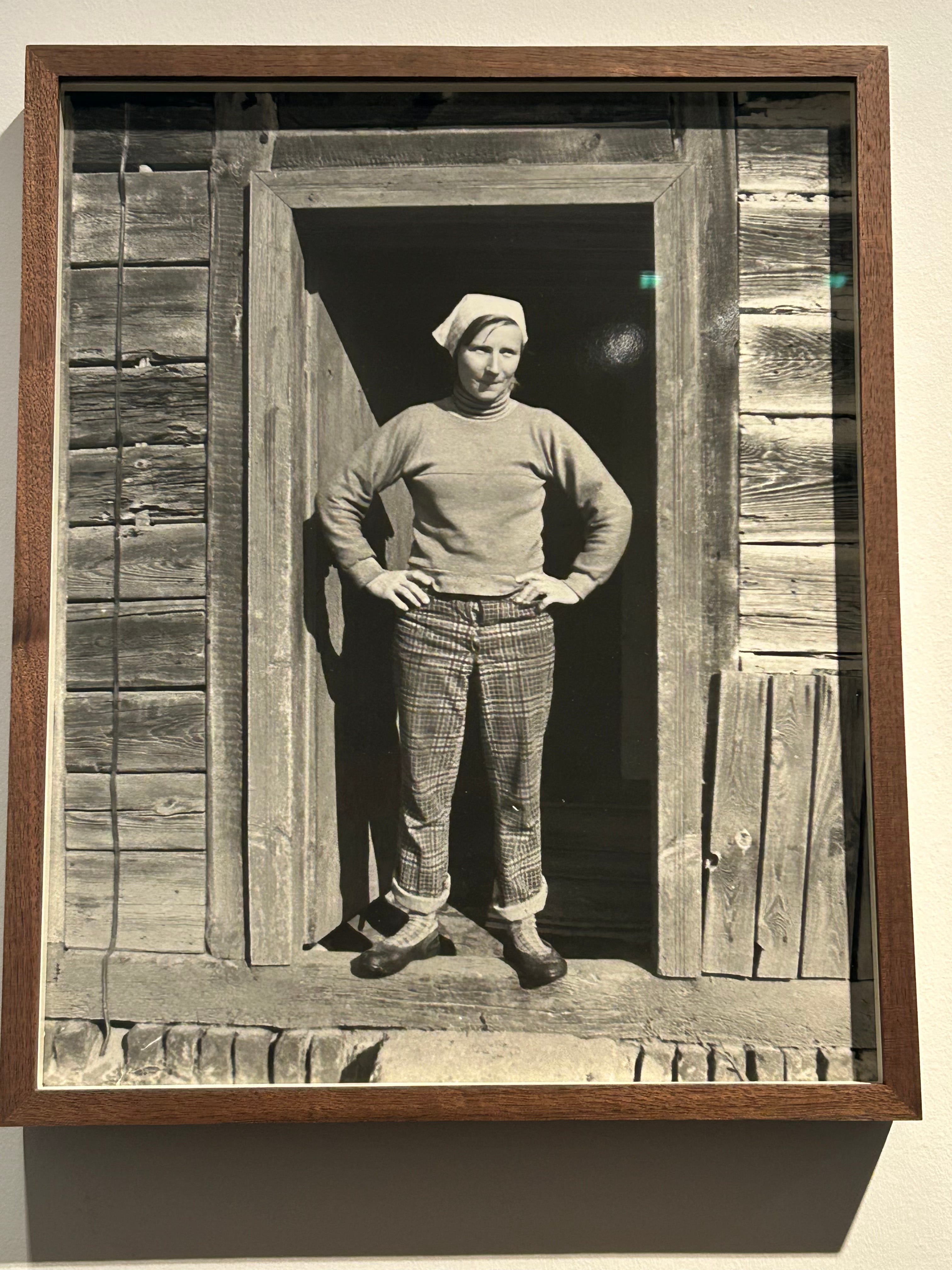
From 1978, when she was 67, Zofia Rydet (1911-1997) set out to photograph the inside of every Polish household. She would approach a home unannounced, knock, and warmly introduce herself and ask the people living there if they would like to take part in her project.
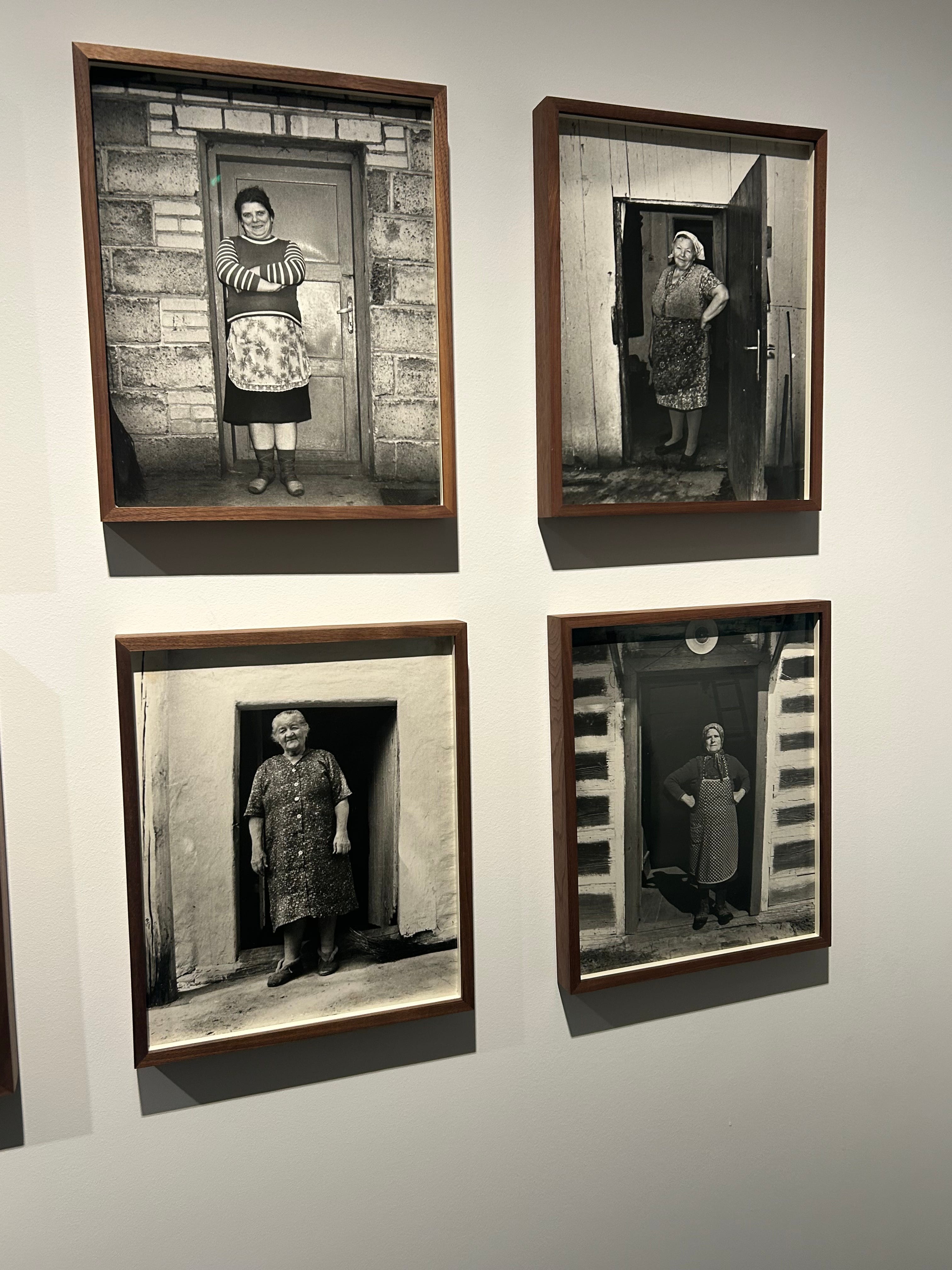
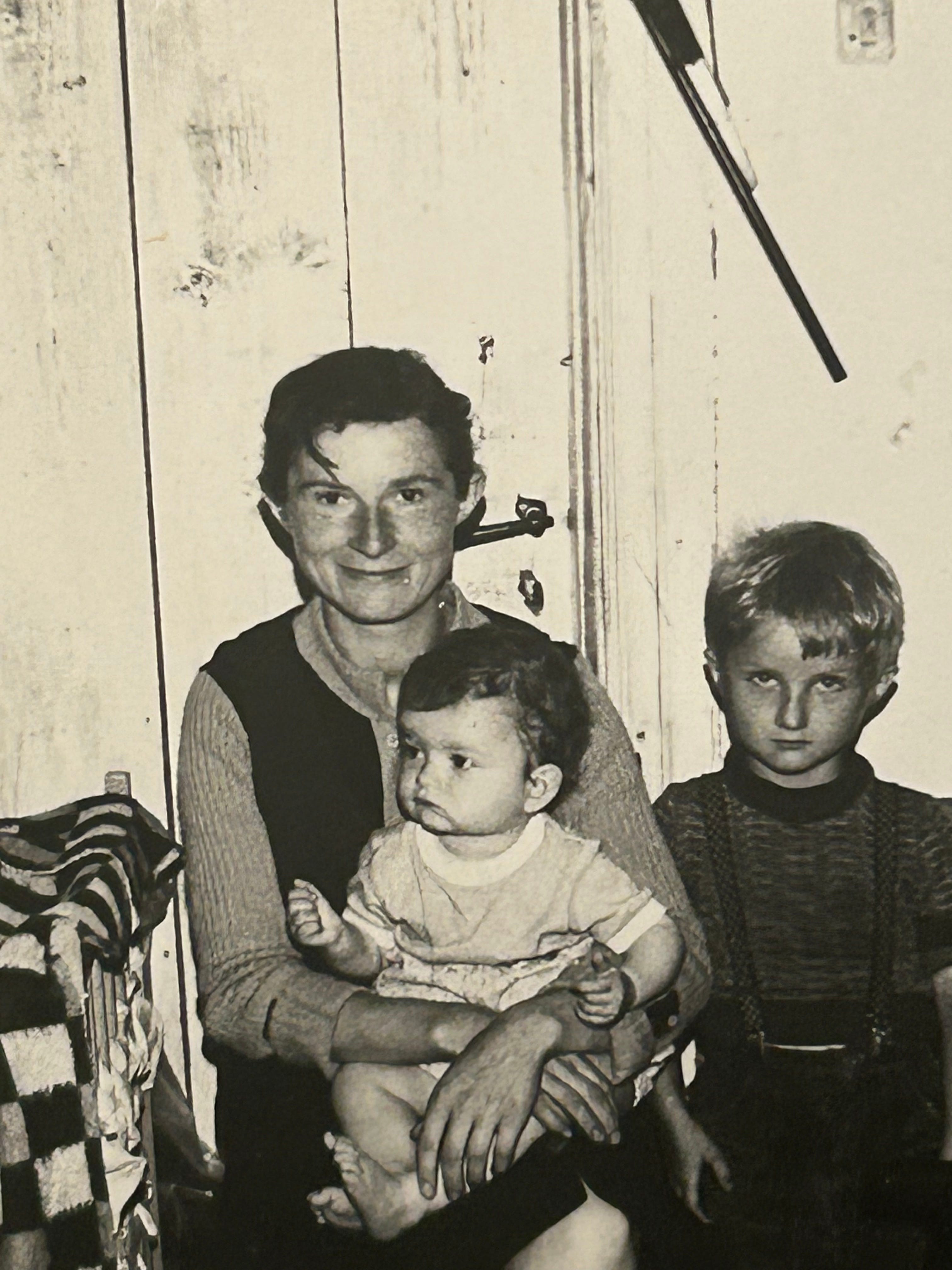
I especially loved her series of Women on Doorsteps, also called Standing Women. It reminds me a lot of Maira Kalman’s, Women Holding Things, something I think about a lot in my work in the context of language. Yes there are also men in Rydet’s photographs but it is the faces of the women from mostly a bygone era in Poland who are holding children and caring for their homes that move me. In a video interview playing in the gallery, Rydet notes how beautiful and interesting she always found the ageing faces of her subjects, and how even when many of these people lived in extreme poverty, they exuded such joy, warmth and wonder.
Here are a few more pics from the exhibit. Thank you for reading.
References:
Dewaele, J-M. (2008) The emotional weight of I love you in multilinguals’ languages. Journal of Pragmatics 40 (10): 1753-1780
Dewaele, J-M., & Salomidou, L. (2017). Loving a partner in a foreign language. Journal of Pragmatics, 108, 116-130.
Pavlenko, A. (2004). 'Stop doing that, ia komu skazala!': language choice and emotions in parent—child communication. Journal of multilingual and multicultural development, 25 (2-3), 179-203.
If the next season of HR needs a linguist to develop Ilya’s multilingual trajectory, I am here for you.
The research on emotional dominance in a first language resonates deeply, but what I find myself sitting with is the parent-child version of this. There are moments with my daughter — when she's upset, or when I'm trying to say something that genuinely matters — where I notice myself reaching for my mother tongue Cantonese. Not consciously. It just arrives first. As though the feeling is already dressed in that language before I've decided to speak.
But then there are other moments where English is actually the more honest language. A lot of my emotional vocabulary around fatherhood, around identity, around the kind of internal questioning that came with adulthood and living between cultures — that was built in English. The Cantonese I grew up with didn't always have the register for it, or if it did, I wasn't given it. So it genuinely depends on the situation. Grief and tenderness might reach for Cantonese. Uncertainty, complexity, self-reflection — sometimes that's English.
What your piece sharpens for me is the question of what my daughter is building, and in which language. Because she's currently acquiring her emotional vocabulary in either Cantonese or Mandatin, but this will likely change to English as she starts attending childcare. Whether Cantonese ever becomes more than functional for her, more than a language we share rather than one she feels in — I don't know yet. That's the part I can't see clearly from where I'm standing, or where I want to stand.
Yet another reason for me to watch HR. Yesterday I was in a class where the teacher had us read some poetry by German poet Mayrocker. She began by giving us a syntax key. Apparently Mayrocker didn’t want to lose the “germanic” elements of her writing when it was translated into English so she (and translator) kept elements of German language by using a particular syntax. We didn’t have time to deep dive into it, but it made me think of you.